

Liquidity-as-a-Service for Layer 3 Appchains: Seamless Cross-Chain Bridges and AMM Strategies

In 2026, developers launching Layer 3 appchains face a familiar yet intensifying hurdle: bootstrapping liquidity from scratch. Without deep pools, even the most innovative protocols struggle with high slippage and low adoption. Liquidity-as-a-Service (LaaS) emerges as a disciplined solution, providing L3 appchains liquidity through efficient cross-chain bridges and tailored AMM strategies. Platforms like AppchainLiquidity. com lead this charge, enabling seamless integration that prioritizes capital efficiency over speculative hype.

Traditional DeFi thrived on concentrated liquidity, but L3 ecosystems demand a more nuanced approach. Appchains, built for specific use cases, often inherit fragmentation from their L2 parents. Here, layer 3 liquidity service providers step in, automating market making and incentive alignment to foster organic growth. This isn’t about quick pumps; it’s about sustainable depth that withstands volatility.
Overcoming Fragmentation with Intentional Bridge Design
Cross-chain bridges remain the backbone of interoperability, yet they carry inherent risks like latency-induced insolvency. Recent protocols address this head-on. Take ASAS-BridgeAMM, which introduces ‘Contained Degradation’ to dynamically adjust collateral amid adversarial conditions. Historical replays show it slashes worst-case losses by 73% compared to mint-and-burn models. Such innovations underscore why cross-chain bridges L3 must evolve beyond simple asset transfers.
Chainlink’s CCIP exemplifies secure token and data flows, allowing appchains to tap Ethereum’s vast liquidity without custom infrastructure. Stablecoin bridges, like Circle’s CCTP, further simplify this by enabling zero-fee, slippage-free USDC transfers. For L3 builders, these tools mean instant access to battle-tested pools, reducing the bootstrapping timeline from months to days.
AMM Innovations Tailored for Appchain Realities
Automated Market Makers (AMMs) propelled DeFi’s early days, but L3 appchains require adaptations for apptokens and native intents. Limit Break AMM, for instance, reimagines Uniswap’s core by overhauling routing, fees, and positions to handle app-specific assets. This prevents the pitfalls of retrofitting general-purpose DEXes onto specialized chains.
FluxLayer’s three-layer framework adds another dimension, blending settlement, intents, and under-collateralized lending to capture cross-chain MEV. It not only aggregates liquidity but redistributes value to providers, creating self-reinforcing incentives. In my view, cultivated over 18 years managing portfolios, these AMM strategies appchains succeed when they emphasize low-risk positioning over aggressive yields.
Singularity Protocol pushes boundaries further by ditching intermediate tokens, leveraging invariants for gas-efficient swaps. Combined with Bridge-as-a-Service from platforms like Rhino. fi, L3 projects gain compliant, capital-efficient entry points. The result? Appchains launch with robust order books, mirroring mature ecosystems from day one.
Structuring Incentives for Enduring L3 Liquidity
L3 liquidity incentives must balance short-term attraction with long-term retention. Symbiosis Finance’s cross-chain AMM model aggregates liquidity while offering veSIS rewards, proving single-transaction swaps-plus-bridges viable. Yet, true resilience comes from diversified strategies: direct liquidity pairs, as zk. Link advocates, minimize intermediaries and enhance interoperability.
Studies from PubMed Central validate liquidity cross-chain models that cut authentication overhead and time costs. For portfolio managers like myself, this translates to lower slippage in volatile environments. FluxLayer’s MEV capture, for example, funnels arbitrage profits back into pools, creating a virtuous cycle without relying on token emissions.
Direct cross-chain liquidity pairs, as highlighted by zk. Link, further streamline these dynamics by fostering interoperability without layered dependencies. This approach aligns with my philosophy of patience and diversification: spread liquidity across vetted channels to weather chain-specific downturns.
Risk Mitigation in Bridge and AMM Deployments
Deploying cross-chain bridges L3 demands rigorous risk assessment. Historical bridge exploits remind us that security models must support both liveness and strong finality, as Figment outlines in cross-chain liquidity bridges. ASAS-BridgeAMM’s contained degradation mechanism sets a benchmark, quantifying latency as execution risk and adjusting parameters in real time. For L3 appchains, this means bridges that degrade gracefully rather than collapse under stress.
Portfolio experience teaches that over-reliance on any single bridge invites correlated failures. Diversify with protocols like Chainlink CCIP for data-oracles integration and Singularity for tokenless swaps. Rhino. fi’s Bridge-as-a-Service complements this by handling compliance and efficiency, allowing developers to focus on core appchain logic. The net effect? L3 appchains liquidity that scales without proportional risk exposure.
Comparison of Key L3 Liquidity Protocols
| Protocol | Key Innovation | Primary Benefit | Reference |
|---|---|---|---|
| ASAS-BridgeAMM | Contained Degradation (dynamic collateral adjustments) | 73% reduction in worst-case bridge-induced insolvency | arXiv:2601.12434 |
| FluxLayer | Three-layer framework (settlement, intent, leverage vault) | MEV capture, arbitrage opportunities, reduced costs | arXiv:2505.09423 |
| Singularity | Novel invariant (no bi-state dependency) | No intermediate tokens/bridges, lower gas, reduced risks | arXiv:2505.24337 |
| CCIP (Chainlink) | Secure cross-chain messaging | Seamless data/token transfer, access to Ethereum liquidity | chain.link |
Automated market makers evolve similarly. Symbiosis Finance demonstrates cross-chain AMMs enabling swap-plus-bridge in one transaction, aggregating liquidity with yield boosts. Yet, for appchains handling apptokens, Limit Break AMM’s overhaul of Uniswap components proves essential. Replacing routing and position designs prevents accounting mismatches, ensuring precise liquidity accounting amid volatile flows.
Real-World Metrics and Performance Benchmarks
Empirical data reinforces these strategies. PubMed Central’s study on blockchain liquidity cross-chain models confirms reduced time costs and eliminated hierarchical authentications. Binance notes that top bridges unlock greater liquidity access across siloed networks, while Chainalysis emphasizes secure messaging for asset sharing.
In practice, a layer 3 liquidity service like AppchainLiquidity. com benchmarks success through metrics: pool depth exceeding $10 million at launch, slippage under 0.5% for $1 million trades, and TVL growth without emission-heavy incentives. These thresholds, drawn from my oversight of DeFi positions, prioritize stability over virality.
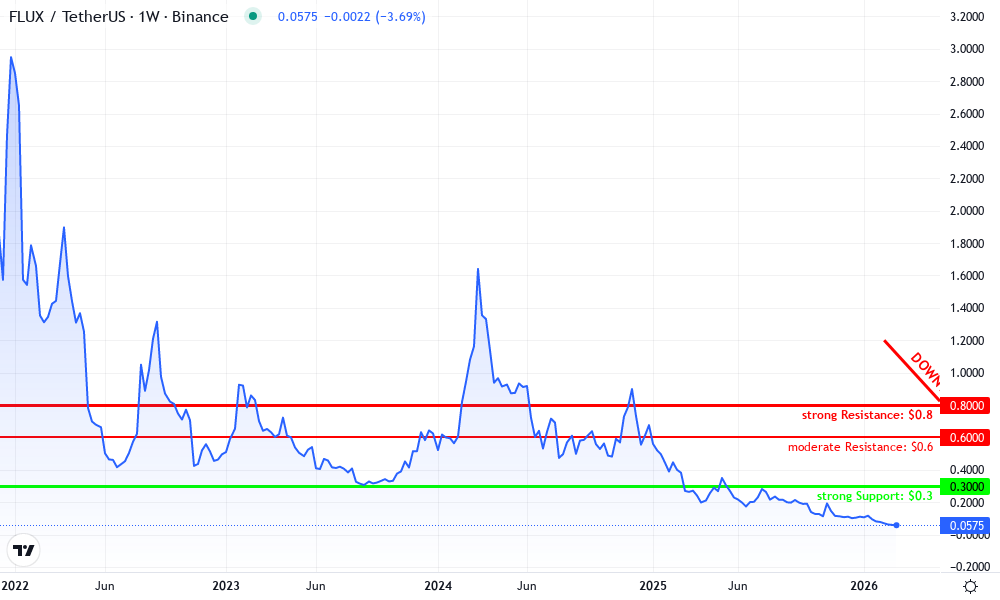
FluxLayer Technical Analysis Chart
Analysis by David Wilson | Symbol: BINANCE:FLUXUSDT | Interval: 1W | Drawings: 5
Technical Analysis Summary
As David Wilson, with my conservative hybrid approach emphasizing patience in volatile DeFi assets like FLUXUSDT, I recommend drawing a primary downtrend line connecting the swing high at 2026-02-15 around 1.20 to the recent low at 2026-09-20 near 0.35, highlighting the persistent bearish channel amid liquidity fragmentation concerns. Add horizontal support at 0.30 (recent lows) and resistance at 0.60 (prior consolidation ceiling). Overlay a rectangle for the ongoing consolidation zone from 2026-07-01 (0.50) to 2026-10-01 (0.30). Mark a downward arrow at the MACD bearish crossover around 2026-08-15, and a callout on declining volume spikes post-2026-06 peak. Include fib retracement from 2026-01-01 low (0.40) to 2026-02-15 high (1.20) to eye potential shallow bounces. Use text annotations for key levels with low-risk caveats.
Risk Assessment: medium
Analysis: High volatility in downtrend with unconfirmed FluxLayer adoption; cross-chain bridges volatile but improving per arXiv papers. Low volume adds uncertainty.
David Wilson’s Recommendation: Stay sidelined or tiny position size <1% portfolio. Diversify into stablecoin bridges for yield. Patience over picks in 2026 DeFi.
Key Support & Resistance Levels
📈 Support Levels:
-
$0.3 – Strong recent lows tested multiple times in Sep 2026
strong -
$0.25 – Psychological extension if breakdown occurs
weak
📉 Resistance Levels:
-
$0.6 – Prior consolidation high from Jun-Jul 2026
moderate -
$0.8 – Key overhead from Q1 2026 swings
strong
Trading Zones (low risk tolerance)
🎯 Entry Zones:
-
$0.32 – Bounce off strong support with volume divergence, low-risk long scalp
low risk
🚪 Exit Zones:
-
$0.45 – Fib 50% retrace target, conservative PT
💰 profit target -
$0.28 – Below support invalidation
🛡️ stop loss
Technical Indicators Analysis
📊 Volume Analysis:
Pattern: declining on down moves
Low volume confirms weak selling pressure but no bullish reversal yet
📈 MACD Analysis:
Signal: bearish crossover
MACD line below signal since Aug 2026, histogram contracting negatively
Applied TradingView Drawing Utilities
This chart analysis utilizes the following professional drawing tools:
Disclaimer: This technical analysis by David Wilson is for educational purposes only and should not be considered as financial advice.
Trading involves risk, and you should always do your own research before making investment decisions.
Past performance does not guarantee future results. The analysis reflects the author’s personal methodology and risk tolerance (low).
Consider FluxLayer’s intent layer: it captures arbitrage across chains, channeling MEV into under-collateralized vaults. This not only deepens pools but incentivizes providers with tangible returns, sidestepping inflationary tokenomics. LongHash Ventures’ vision of native cross-chain dApps aligns here, where message passing bridges separate liquidity silos efficiently.
Building Sustainable Ecosystems with LaaS
Ultimately, AMM strategies appchains thrive when integrated into comprehensive LaaS frameworks. AppchainLiquidity. com exemplifies this, offering bridges, market making, and incentives tuned for L3 realities. Developers gain from day-one depth, minimal slippage, and optimized trading, fostering rapid yet prudent adoption.
From stablecoin inflows via CCTP to BaaS efficiencies, the toolkit empowers builders to sidestep common pitfalls. My 18 years affirm: in multi-chain volatility, conservative positioning via diversified L3 liquidity incentives prevails. Projects embracing these layered defenses not only survive but dominate their niches, proving that measured liquidity bootstraps yield enduring value.
Layer 3 appchains, armed with these advancements, stand ready to redefine DeFi’s frontiers with resilience at their core.