

In the rush to launch Layer 3 appchains, developers face a stark reality: without deep liquidity from day one, user adoption stalls amid punishing slippage. New chains, optimized for specific applications, inherit the multi-chain ecosystem's fragmentation problem, where capital scatters across Ethereum L2s, Solana, and beyond. Liquidity-as-a-Service (LaaS) bridges emerge as a disciplined solution, fronting capital via sophisticated pools and market-making to deliver tight spreads and seamless transfers. This approach, rooted in patient capital strategies, ensures L3 appchains bootstrap trading volumes without the volatility traps of bootstrapped incentives alone.

Fragmentation isn't abstract; it's a measurable drag on efficiency. Cross-chain volume often skews unidirectional, starving platforms of balanced liquidity needed for sustainable growth. Traditional bridges rely on mint-and-burn mechanisms, exposing users to settlement delays and counterparty risks. In contrast, liquidity pool-based bridges, managed by providers depositing equivalent assets, enable near-instant swaps. Yet, even these falter under low depth, amplifying slippage in new L3 chains - that dreaded gap between expected and executed prices.
Liquidity Fragmentation: The Silent Killer of L3 Launches
Crypto markets splinter further with each appchain debut. Liquidity disperses across chains, exchanges, and OTC desks, creating silos that inflate trading costs. Low liquidity pools breed high slippage, eroding trust in nascent ecosystems. Historical lessons from trading underscore this: multi-layered market making sustains depth through volatility, but new L3s lack the volume to attract it organically.
Consider the mechanics. L3 cross-chain bridges must bridge not just tokens but sustained trading activity. Liquidity-network bridges front capital for instant moves, settling asynchronously, but one-way flows deplete pools. This imbalance hampers automated market making for appchains, as providers face impermanent loss without reciprocal activity. The result? Developers burn incentives on airdrops, only to watch capital flee to deeper venues.

LaaS Bridges: Engineering Depth from Day One
Liquidity as a service for L3 flips the script by outsourcing bridge infrastructure to specialists. These platforms deploy pre-funded pools, automated market makers, and incentive alignments to seed depth. Unlike ad-hoc solutions, LaaS emphasizes capital efficiency, using shared liquidity layers to serve multiple appchains without siloed deployments.
Pool-based architectures shine here. Providers stake assets on both sides of the bridge, enabling atomic-like swaps. Dynamic adjustments - collateral haircuts, slippage bounds - mitigate risks, as seen in innovations like contained degradation models that cut insolvency risks by over 70%. This trust-minimized design suits volatile launches, where adversarial flows test resilience.
Market makers play a pivotal role, layering strategies to absorb imbalances. By integrating intents, ZK proofs, and AI routing, LaaS platforms aggregate the best liquidity across fragments. This isn't hype; it's the endgame for cross-chain optimization, where solvers, exchanges, and bridges compete to minimize user costs.
Emerging Protocols Redefining L3 Liquidity Bootstrapping
Recent advancements spotlight LaaS's potential. Rhino. fi's Bridge-as-a-Service delivers stablecoin depth to OP Stack and CDK chains, masking complexity behind single-transaction deposits. LiquidChain L3 coordinates settlements across Bitcoin, Ethereum, and Solana, offering unified applications for atomic swaps and portfolio views.
Synthr's omnichain debt pool acts as universal counterparty, promising zero-slippage swaps by netting positions globally. Mitosis Protocol goes further, providing chain-native liquidity sans local AMMs via shared pools - a boon for developers slashing capital needs while enhancing prices.
These protocols exemplify how L3 appchain liquidity bridges can evolve beyond mere transfers into full-spectrum liquidity engines. ASAS-BridgeAMM's contained degradation mechanism stands out, dynamically tuning parameters to slash insolvency risks by 73% over legacy systems. Such resilience matters in launches where speculative inflows reverse abruptly, testing bridge integrity.
Arbitrum Technical Analysis Chart
Analysis by Jessica Nguyen | Symbol: BINANCE:ARBUSDT | Interval: 1W | Drawings: 6
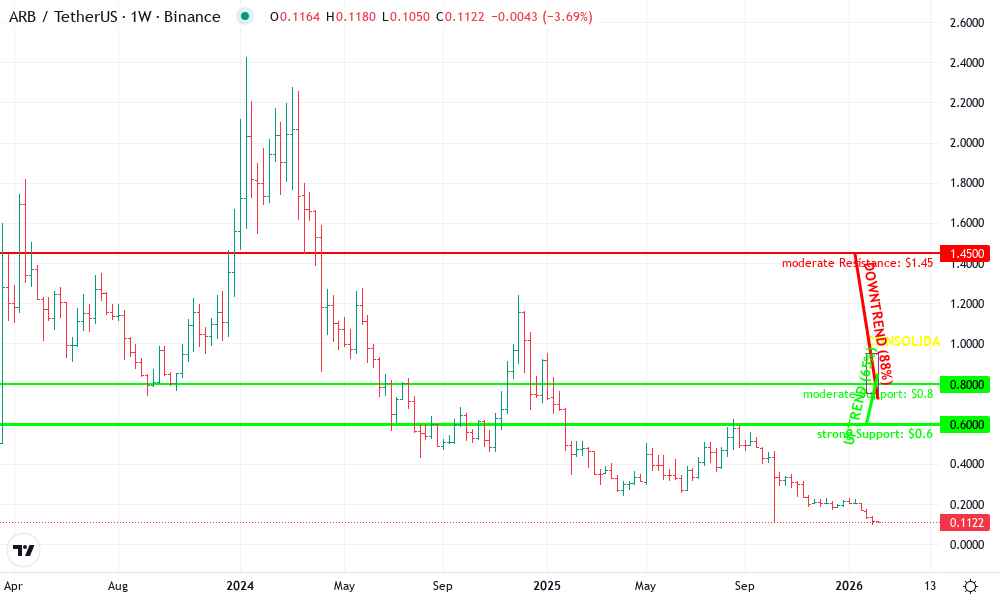
Technical Analysis Summary
In my conservative style, draw a prominent downtrend line (trend_line) connecting the January 2026 high at 1.45 on 2026-01-15 to the current level near 0.72 on 2026-02-12, highlighting the persistent bearish channel amid liquidity fragmentation. Add horizontal lines (horizontal_line) at key support 0.60 (strong) and 0.80 (moderate), and resistance at 1.20 and 1.45. Enclose the recent consolidation in a rectangle (rectangle) from 2026-01-28 (0.75-0.95) to present. Use callouts (callout) to note declining volume divergence and MACD bearish crossover below zero. Mark potential entry zone with long_position rectangle near 0.80 if liquidity inflows confirm, and text annotations for appchain bridge catalysts.
Risk Assessment: high
Analysis: Persistent downtrend and liquidity fragmentation elevate volatility risks in this appchain token; low tolerance demands confirmation
Jessica Nguyen's Recommendation: Remain sidelined with patient capital; monitor for Mitosis/Synthr adoption signals before low-risk long entry
Key Support & Resistance Levels
📈 Support Levels:
- $0.8 - Recent swing low with volume cluster moderate
- $0.6 - Major psychological and historical base strong
📉 Resistance Levels:
- $1.2 - Near-term overhead from Feb consolidation high weak
- $1.45 - Prior monthly high, liquidity resistance moderate
Trading Zones (low risk tolerance)
🎯 Entry Zones:
- $0.8 - Bounce from moderate support with improving volume, aligned to low-risk tolerance post-liquidity news low risk
🚪 Exit Zones:
- $1.2 - Initial profit target at weak resistance 💰 profit target
- $0.72 - Tight stop below current lows to preserve capital 🛡️ stop loss
Technical Indicators Analysis
📊 Volume Analysis:
Pattern: Declining on downside, bullish divergence suggesting exhaustion
Volume fading on recent lows indicates potential distribution end, watch for spike on liquidity inflows
📈 MACD Analysis:
Signal: Bearish crossover below zero line
Momentum weakening further, but histogram contracting hints at possible reversal if appchain catalysts hit
Applied TradingView Drawing Utilities
This chart analysis utilizes the following professional drawing tools:
Disclaimer: This technical analysis by Jessica Nguyen is for educational purposes only and should not be considered as financial advice. Trading involves risk, and you should always do your own research before making investment decisions. Past performance does not guarantee future results. The analysis reflects the author's personal methodology and risk tolerance (low).
Developers benefit immensely from this shift. Traditional launches demand massive upfront capital for local AMMs, often tying up funds in illiquid positions prone to impermanent loss. Liquidity as a service L3 platforms like Mitosis liberate that capital, tapping shared pools for native-depth trading. Users see tighter spreads; a perp dex on a fresh appchain might offer 5bps slippage where bootstrapped efforts hit 200bps. This gap compounds: high costs deter traders, stifling volume and network effects.
Risks and Mitigation: Patient Capital in Action
Yet optimism tempers with caution. Cross-chain bridges carry smart contract vulnerabilities and oracle dependencies, amplified in low-volume L3s. Unbalanced flows remain a threat; market makers must deploy layered strategies - from concentrated liquidity to AI-driven rebalancing - to maintain equilibrium. My experience managing billions in traditional portfolios underscores this: liquidity thrives on patience, not frenzy. Volatile chains demand patient capital, committed long-term to weather drawdowns.
LaaS mitigates via diversified providers. Solvers compete on intents, routing through optimal paths with ZK proofs for verifiability. Global debt pools, as in Synthr, net exposures to neutralize directional bets. Rhino. fi's stablecoin focus sidesteps volatility, channeling USD equivalents directly into appchain perps. These layers create a buffered ecosystem, where individual pool drains trigger automatic arbitrages rather than cascades.
Implementation demands rigor. Appchain teams should prioritize protocols with proven TVL and audit histories. Integrate automated market making appchains early, aligning incentives via epoch-based rewards vested over quarters. This discourages mercenary capital, fostering organic growth. Metrics to track: pool imbalance ratios under 10%, average slippage below 50bps on $100k trades, and bridge uptime exceeding 99.9%.
The Multi-Chain Future: Seamless, Slippage-Free
Looking ahead, L3 cross-chain bridges will converge with intent-centric architectures. Users declare outcomes - 'swap USDC for appchain native at best rate' - while solvers handle fragmentation. AI enhances this, predicting flows to preposition liquidity. The result: appchains launch as liquidity-rich as mature L2s, accelerating DeFi's app-layer proliferation.
From my vantage, having pivoted from TradFi to DeFi interoperability, the key lies in disciplined bootstrapping. LaaS isn't a silver bullet but a foundational tool for minimize slippage new L3 chains. By fronting depth patiently, it bridges not just assets but viability gaps. Teams embracing these services position for enduring ecosystems, where trading efficiency begets adoption, and adoption begets self-sustaining liquidity. In this fragmented landscape, such engineering proves decisive.




No comments yet. Be the first to share your thoughts!