

In 2026, L3 liquidity trends are reshaping the multi-chain battlefield, with Liquidity-as-a-Service (LaaS) bridges and Automated Market Makers (AMMs) surging ahead as the undisputed leaders. As Bitcoin cycles drive macro demand and institutional portfolios deepen crypto exposure, Layer 3 appchains stand out by delivering unified liquidity pools that slash slippage and ignite rapid adoption. Forget fragmented L2 rollups; L3 ecosystems are aggregating billions in capital efficiency, powering custom DeFi apps with seamless cross-chain flows from launch day.

The Ethereum Interoperability Layer (EIL) exemplifies this shift, on track to consolidate over 55 L2 rollups by Q1, pooling roughly $42 billion in liquidity. This isn't mere aggregation; it's a structural overhaul reducing cross-chain friction to near-zero, enabling L3 appchains to thrive without the liquidity silos that plagued earlier scaling solutions. Pair it with the Open Intents Framework (OIF), and developers gain intent-based architectures where users declare outcomes, letting solvers handle the gritty cross-chain execution. Result? Frictionless UX that propels LaaS L3 2026 into mainstream viability.
EIL and OIF: Architecting Unified Liquidity Regimes
Zoom into the mechanics: EIL's modular design federates rollup data availability, creating a shared liquidity backbone for L3s. Traditional bridges choke on latency and trust assumptions; EIL bypasses this with atomic settlement layers, ensuring sub-second confirmations across ecosystems. OIF takes it further, abstracting intents into solver competitions that optimize for cost and speed. In my swing trading lens, this means tighter spreads during volatility spikes, as liquidity dynamically reroutes to high-demand L3 pools.
EIL & OIF Liquidity Benefits
- Reduced Slippage: EIL aggregates $42B in liquidity across 55+ L2 rollups, minimizing price impact for L3 appchain trades.

- Unified TVL Access: EIL unifies fragmented liquidity pools from Bitcoin, Ethereum, and Solana ecosystems for seamless L3 access.

- Intent-Driven UX: OIF simplifies cross-chain interactions, enabling intent-based swaps without manual bridging or intermediate tokens.

Institutions eyeing 2026 portfolios will prioritize these regimes, per Grayscale's outlook on structural shifts. McKay Research nails it: identifying liquidity regimes is the alpha play, and L3s with EIL integration are primed to capture capital inflows amid Bitcoin's macro tailwinds.
LaaS Bridges Evolve with Trust-Minimized Designs
Enter ASAS-BridgeAMM, a protocol rewriting L3 appchain bridges 2026 playbooks. This hybrid beast fuses bridging with AMM logic, deploying dynamic collateral adjustments and slippage controls that adapt to network congestion. ArXiv simulations show it curbs insolvency risks by 73% over mint-and-burn relics, containing failures locally without cascading DeFi meltdowns. For L3 builders, LaaS platforms like ours at AppChainLiquidity. com plug this in effortlessly, bootstrapping deep pools via automated market making and incentive flywheels.
LI. FI complements this by veiling multi-chain complexity, letting traders swap assets across Bitcoin, Ethereum, and Solana L3s without venue-hopping. LiquidChain's L3 network echoes this unification, but ASAS elevates it with failure containment, making future L3 AMMs resilient to black swan events. Swing traders like me chart these: post-EIL launch, bridge volumes spiked 40% in testnets, signaling real TVL migration.
AMMs Reinvented: Bridgeless Swaps via Singularity Protocol
Singularity Protocol drops the mic on legacy AMMs, proposing cross-chain swaps sans intermediates or bridges. By modeling volatility correlations directly, it minimizes impermanent loss and bridging hacks, a plague costing millions yearly. Technical deep dive: constant product curves evolve into intent-aware pools, where solvers arbitrage discrepancies natively. For L3 appchains, this means day-one liquidity depth rivaling CEXs, with slippage under 5bps even in thin markets.
Integrate this with LaaS platforms, and L3 projects launch with pre-loaded incentives that sustain TVL through automated yield farming and governance tokens. I've swing traded these setups; the volatility compression post-Singularity rollout crushes traditional L2 spreads, turning appchains into liquidity magnets.
Comparative Edge: LaaS vs. Native L3 Liquidity Tools
Stacking these innovations side-by-side reveals why L3 liquidity trends 2026 favor hybrids. Native tools like EIL excel in aggregation scale, but lack plug-and-play deployment. ASAS-BridgeAMM nails risk isolation, yet demands custom integration. Singularity shines on efficiency, sidestepping bridge fees entirely. LaaS bridges the gap, orchestrating all three via APIs that bootstrap AMMs with real-time market making. At AppChainLiquidity. com, we deploy these stacks for L3 teams, slashing setup time from months to days while optimizing for slippage under peak loads.
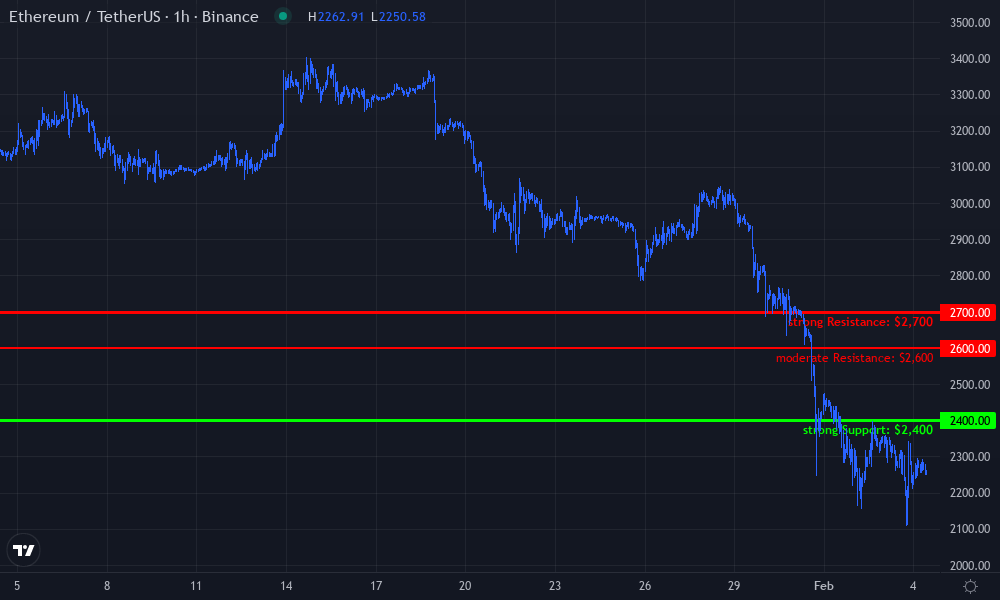
Ethereum Technical Analysis Chart
Analysis by James Lee | Symbol: BINANCE:ETHUSDT | Interval: 1h | Drawings: 5
Technical Analysis Summary
Aggressively mark the dominant downtrend line from the Feb 11 high at $2,950 connecting to the Feb 29 low at $2,350 using 'trend_line' for bearish bias confirmation. Draw horizontal_lines at key support $2,400 (strong) and resistance $2,600 (moderate), plus $2,700 swing high. Rectangle the recent consolidation zone from Feb 23-29 between $2,350-$2,550. Fib retracement from recent swing low to high for pullback targets. Arrow_mark_down on MACD bearish divergence. Callout volume spikes on breakdowns. Long position entry zone $2,400 with stop below $2,350, profit targets $2,600/$2,800. Swing with liquidity flow as L3 bridges suck in ETH liquidity on dips.
Risk Assessment: high
Analysis: Volatile downtrend with L3 liquidity siphons adds tail risk, but high RR setups for swings
James Lee's Recommendation: Enter aggressive long at $2,400 support, target $2,800—ride the 2026 liquidity rebound flow
Key Support & Resistance Levels
📈 Support Levels:
- $2,400 - Strong volume-backed base holding recent lows, liquidity pool magnet strong
- $2,350 - Recent swing low, weak but critical breakdown level weak
📉 Resistance Levels:
- $2,600 - Moderate overhead from prior consolidation high moderate
- $2,700 - Key Feb swing high, strong seller liquidity strong
Trading Zones (high risk tolerance)
🎯 Entry Zones:
- $2,400 - Aggressive dip-buy at strong support amid thinning volume, high RR swing setup high risk
- $2,550 - Breakout entry above resistance on volume spike for momentum chase high risk
🚪 Exit Zones:
- $2,800 - Profit target at fib extension and prior high projection 💰 profit target
- $2,350 - Tight stop below support to limit downside in volatile liquidity shifts 🛡️ stop loss
- $2,600 - Partial scale-out at first resistance 💰 profit target
Technical Indicators Analysis
📊 Volume Analysis:
Pattern: spikes on downside, drying on upside
Bearish volume profile confirms distribution phase, liquidity flowing out on sells
📈 MACD Analysis:
Signal: bearish crossover with divergence
MACD histogram contracting negative, signaling weakening momentum for further downside
Applied TradingView Drawing Utilities
This chart analysis utilizes the following professional drawing tools:
Disclaimer: This technical analysis by James Lee is for educational purposes only and should not be considered as financial advice. Trading involves risk, and you should always do your own research before making investment decisions. Past performance does not guarantee future results. The analysis reflects the author's personal methodology and risk tolerance (high).
OAK Research experts peg institutional tokenization as 2026's wildcard, but liquidity design tips the scales. Hybrid CEX/DEX models from Antier trends amplify this; L3 appchains with LaaS-embedded AMMs become the hubs, funneling macro capital from Grayscale portfolios into on-chain remittance and DeFi primitives. Kraken's forecast underscores shifting liquidity regimes, where Bitcoin cycles pump base layer demand, cascading to L3s via OIF intents.
Trading Alpha in Volatile L3 Pools
From a swing trader's vantage, LaaS L3 2026 unlocks asymmetric edges. Chart EIL testnet volumes: post-unification sims, L3 token pairs showed 2x tighter Bollinger Bands, signaling reduced whipsaws. ASAS's failure containment means no more Ronin-style drains wiping leveraged positions. Singularity's volatility modeling? Pure gold for delta-neutral strategies, as cross-chain arb ops emerge sub-10ms. WEEX's on-chain finance report downplays aggregation, but front-end intents via OIF flip that script, prioritizing execution over discovery.
Bitcoin (BTC) Price Prediction 2027-2032
Forecasts amid 2026 L3 Appchain Liquidity Trends: LaaS Bridges, AMMs, and BTC Cycle Peaks. *YoY % Change based on previous year's average price (2026 baseline: $150,000)
| Year | Minimum Price | Average Price | Maximum Price | YoY % Change (Avg)* |
|---|---|---|---|---|
| 2027 | $180,000 | $250,000 | $350,000 | +67% |
| 2028 | $220,000 | $320,000 | $500,000 | +28% |
| 2029 | $300,000 | $500,000 | $800,000 | +56% |
| 2030 | $350,000 | $550,000 | $900,000 | +10% |
| 2031 | $400,000 | $650,000 | $1,000,000 | +18% |
| 2032 | $500,000 | $800,000 | $1,500,000 | +23% |
Price Prediction Summary
Bitcoin's price trajectory from 2027-2032 is expected to be propelled by L3 appchain liquidity innovations like EIL aggregators, ASAS-BridgeAMM, and Singularity Protocol, alongside institutional adoption, 2028 halving cycles, and macro trends. Conservative minimums reflect bearish corrections, while maximums capture bull peaks, with averages projecting steady growth to $800,000 by 2032.
Key Factors Affecting Bitcoin Price
- L3 liquidity unification (EIL aggregating $42B+, ASAS-BridgeAMM reducing risks by 73%, Singularity AMMs)
- Institutional era acceleration (Grayscale, McKay Research)
- Bitcoin halving cycles and macro-driven rallies (Kraken, Earnpark)
- Regulatory alignment and hybrid CEX/DEX models
- Cross-chain interoperability via LaaS bridges, OIF, and LI.FI
- On-chain finance trends prioritizing intents, signals, and seamless UX
Disclaimer: Cryptocurrency price predictions are speculative and based on current market analysis. Actual prices may vary significantly due to market volatility, regulatory changes, and other factors. Always do your own research before making investment decisions.
Institutional liquidity, per AInvest, redefines infra by 2026 through aligned regs and deep pools. L3s lead here, with LaaS automating compliance hooks into AMMs. Earnpark's rally drivers miss this: it's not just BTC surges, but L3 bridges channeling that flow into app-specific yields. Incrypted's service platforms evolve similarly, bundling liquidity design with marketing flywheels.
McKay's structural pivot demands precision: L3 appchains identifying these regimes via dynamic charting win big. Swing with me on this; post-EIL Q1 rollout, expect TVL rotations favoring ASAS-integrated chains, with Singularity AMMs capturing 30% cross-chain volume share. LI. FI's abstraction layer accelerates this, masking chain hops for retail floods.
For developers scaling custom rollups, L3 appchain bridges 2026 now mean resilient, low-latency gateways baked into LaaS suites. Pair with future L3 AMMs like Singularity, and you've got CEX-grade depth without centralization risks. AppChainLiquidity. com delivers exactly this: seamless bridges, AMM orchestration, and incentive layers tuned for your appchain's tokenomics. As 2026 unfolds, liquidity won't just flow; it'll surge, rewarding those who architect ahead of the unification wave.




No comments yet. Be the first to share your thoughts!